QR payment vs. payment terminal: what pays off for a small business?
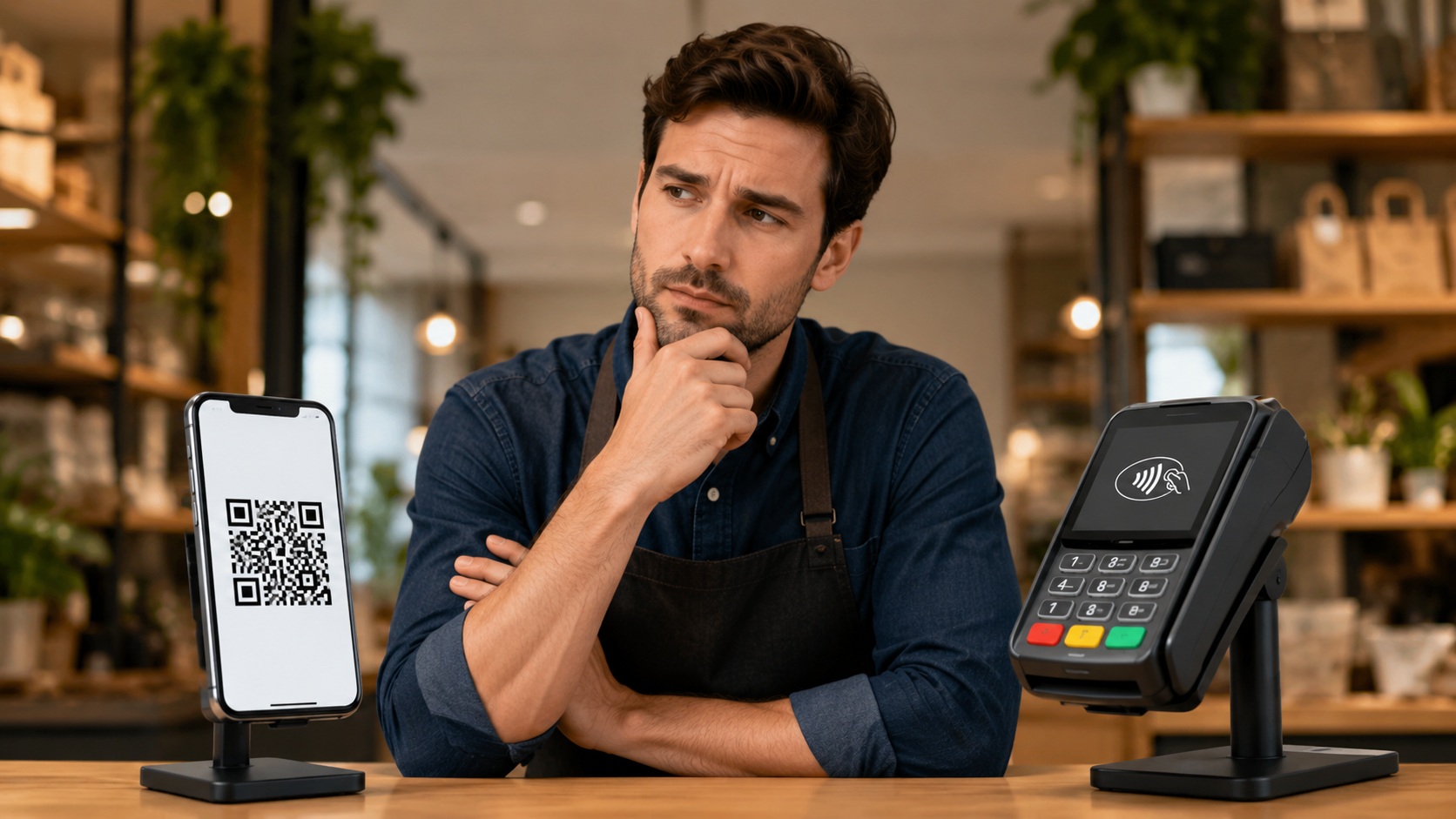
A small business does not always need to start with a traditional payment terminal. In many cases, a QR payment can be a simpler option — but the right choice depends on the type of business, number of payments and customer expectations.
In short
A payment terminal is convenient mainly where customers often pay by card. A QR payment can be a good option for smaller businesses, field services or entrepreneurs who want a simple cashless payment method without an extra device. The key is that the solution is clear for the customer and easy for the business owner to check.
Why more business owners are asking this question
Cashless payments have become a normal part of everyday life. Customers often expect to pay by card, mobile phone, smartwatch or by simply scanning a QR code. For larger businesses, a payment terminal is usually a natural choice. For small businesses, however, the decision is not always so clear.
A sole trader, craftsman, hairdresser, small service business or seller at an event may have a different question: do I really need a terminal, or is a simpler cashless payment method enough? The answer depends on how often payments are accepted, what amounts customers pay and how quickly the business needs confirmation that the payment has been made.
QR payment or terminal?
A payment terminal is very convenient. The customer taps a card or phone, the payment is processed and the business receives immediate feedback. For businesses with many daily payments, this is often the most practical option.
A QR payment, on the other hand, is interesting mainly where the business owner does not want to deal with another device, monthly terminal fees or additional terminal contracts. The customer scans a QR code and completes the payment in their banking app. If the payment details are prepared correctly, the customer does not have to manually copy the IBAN, amount or payment reference.
When a QR payment makes sense
- when you have a lower number of daily payments,
- when you work in the field or at the customer’s location,
- when you do not want to carry a separate payment device,
- when you need a simple way to receive payment to your account,
- when you want better payment identification using amount, reference or note.
Important note
A QR payment is not a replacement for everything. It is one possible cashless payment method. For some businesses it will be ideal; for others, a terminal will be faster and more convenient. The best solution is the one a customer understands within seconds and the business can use every day without stress.
Simple comparison
Choosing between a QR payment and a terminal does not have to be complicated. It is enough to honestly look at how your business works and what you expect from the payment process.
| Solution | Advantage | When it pays off |
|---|---|---|
| QR payment | Simple use without a terminal, payment through a banking app | Smaller businesses, field services, irregular payments |
| Payment terminal | Fast card payment and a familiar method for the customer | Retail, hospitality, businesses with frequent payments |
| Mobile solution | Flexibility, less hardware, easier use on the move | Sole traders, craftsmen, services outside a fixed location |
Practical example
Imagine a small service technician. They help several customers per day, often outside an office or shop. Not every customer has cash, and the technician does not want to lose a job just because they do not have a terminal.
In that case, a QR payment can be very practical. The technician shows the customer a QR code with the correct amount and payment details. The customer scans it in their banking app and sends the payment. If the payment is properly marked, the business owner can identify it more easily later.
On the other hand, if the business has a high number of customers, such as a café or shop, a terminal may be more convenient. Payments are fast, staff do not need to explain the process, and customers use a method they already know.
What to watch out for
With QR payments, it is important that the customer knows exactly what to do. Simply saying “send it to my account” is not enough. A prepared QR code with the amount, IBAN and payment identification looks more professional and reduces mistakes.
Recommended
Test the payment process in advance, show a clear amount, use payment identification and choose a solution that even a less technical customer can complete easily.
Watch out for
Unclear payment details, missing amount, incorrect IBAN, weak internet connection, untested solutions or situations where the customer cannot easily complete the payment.
Frequently asked questions
Conclusion
QR payments and payment terminals both have their place. A terminal is excellent where payments are frequent and speed is essential. A QR payment can be more practical for smaller businesses that want a simple cashless solution without unnecessary technical burden.
The most important thing is to choose a method that makes sense for the specific business. If the payment is simple for the customer and clear for the business owner, what begins as an obligation can become an advantage.
Do you want to start with QR payments simply?
For small businesses, a QR payment can be a quick way to offer customers a cashless payment option without a traditional terminal.
I want to try QR PAYMENT