Cashless payments in Slovakia: what is changing and what businesses should know
Slovakia is gradually moving toward more modern payment methods. Cash is not disappearing, but businesses will increasingly need to offer customers a simple cashless payment option as well.
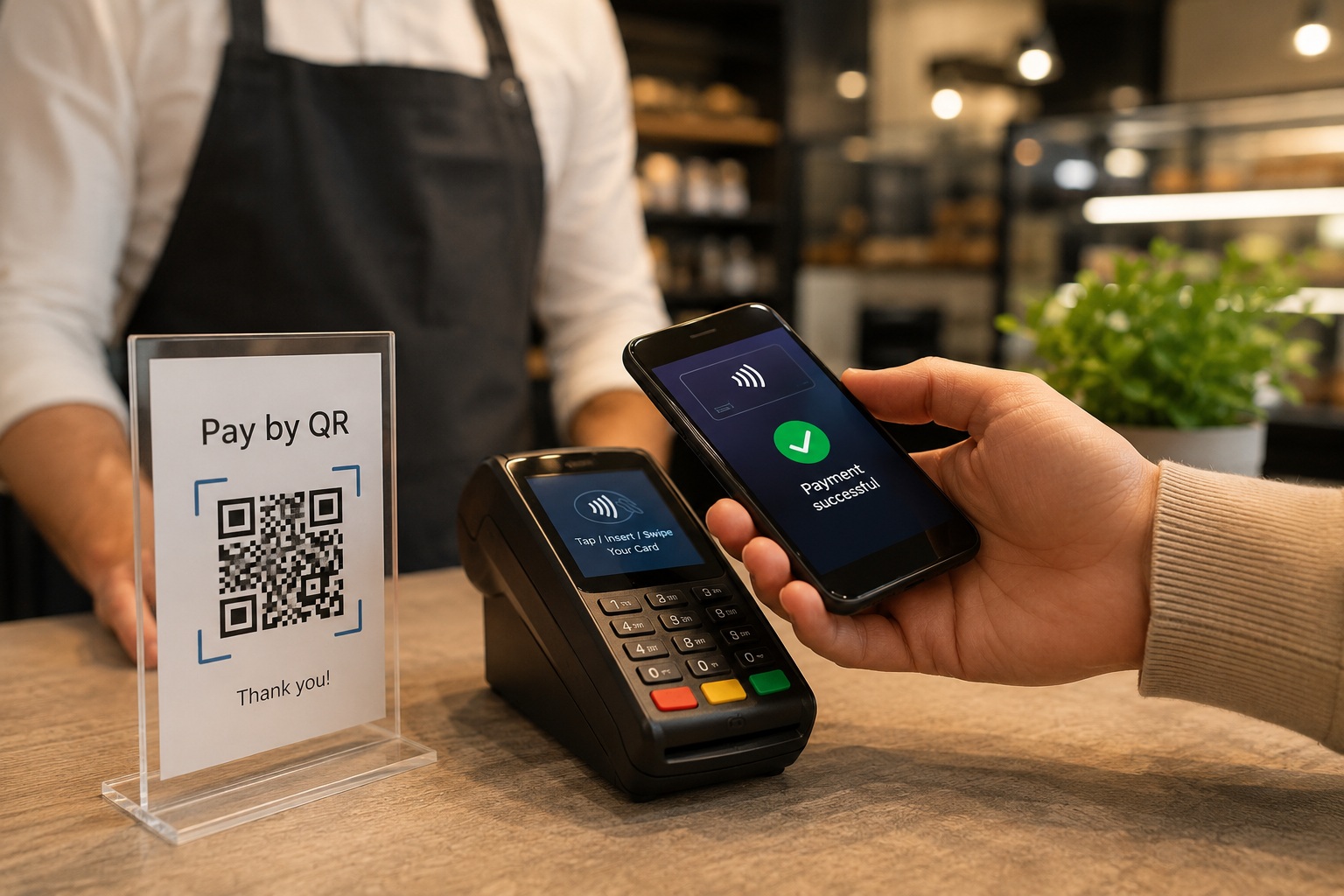
In short
From 1 March 2026, sellers who accept payments at a point of sale in Slovakia are expected to enable a cashless payment option for transactions above 1 euro. This does not mean the end of cash. It means that customers should have at least one available cashless way to pay.
Why cashless payments are becoming more important
Card payments, mobile payments, smartwatch payments and QR payments have become a normal part of everyday life. Customers are used to paying quickly, without looking for coins and without needing to visit an ATM. For many people, a cashless payment is no longer a bonus, but a natural expectation.
For a small business owner, sole trader or a business with a lower number of transactions, introducing cashless payments may not always feel like an easy decision. Fees, technical setup, internet connection, accounting, sales registration and the practical question of what actually makes sense for the business all matter.
That is why it is better to look at cashless payments not as a complication, but as another way to make purchasing easier for the customer. If customers can pay in a way that suits them, the chance that they postpone the purchase or go to a competitor is lower.
What changes from 1 March 2026
According to information published by the Financial Administration of the Slovak Republic regarding the registration of sales, if a seller accepts payments at a point of sale, from 1 March 2026 the seller will be required to enable a cashless payment option for transactions above 1 euro. Examples include card payment, QR payment or another cashless method.
In practice, this means that a business should have at least one working way for customers to pay cashlessly. It does not always have to be a traditional payment terminal. A business may choose a solution that best fits its type of operation, technical conditions and transaction volume.
At the same time, every accepted payment for goods or services must still be properly recorded in the cash register system, and the customer must receive a receipt with the required information. A cashless payment does not replace the obligation to register sales; it only adds another way for the customer to pay.
Important: it is not only about payment cards
A cashless payment does not necessarily mean a card terminal only. According to the Financial Administration, it may also be a QR payment or another cashless method. This is especially important for smaller businesses, craftsmen, field services or entrepreneurs looking for a simpler solution.
Cash is not disappearing
It is also important to say what is not changing. The new rules do not mean that cash is being abolished. Customers will still be able to pay in cash. The change is that for purchases above 1 euro, customers should also be able to ask for a cashless payment option.
For customers, this expands their choices. For businesses, it means being prepared to offer at least one cashless payment method in normal situations. In practice, this may be a payment terminal, a QR code, an app or a solution connected to a cash register system.
This distinction is also important when communicating with customers. The goal is not to push cash away, but to complement it with a modern payment method that many people already use every day.
Which payment options can a business choose
A business should choose a solution based on how it actually operates. A café with dozens of daily card payments has different needs than a mobile service technician, hairdresser, craftsman or small seller at occasional events.
Common options
- Payment terminal – suitable mainly for businesses with regular card payment volume.
- Mobile application – practical for field services or smaller operations.
- QR payment – the customer scans a code and completes the payment in their banking app.
- Solution integrated with a cash register – useful where connection with an eKasa system is needed.
- Commercial solution from a payment service provider – it is important to check terms, fees and technical support.
The National Bank of Slovakia also explains that payment services, such as fund transfers, issuing payment instruments or acquiring and processing card transactions for merchants, may be provided only by payment service providers, such as banks or payment institutions. This is why it is sensible to choose solutions built on trustworthy and regulated infrastructure.
Instant payments are changing practical expectations
One major advantage of modern cashless solutions is instant payment. The National Bank of Slovakia states that from 9 January 2025, all banks are connected to the instant payments system and all clients can receive instant payments into their accounts. In practice, with a supported solution, a payment can be credited within seconds, including outside business hours, during weekends and on public holidays.
A practical example from everyday business
Imagine a small business that has mostly accepted cash so far. A customer comes to pay for a service worth 18 euros but does not have cash. Previously, they would have had to look for an ATM or postpone the payment. With the new expectations, it is sensible to have a simple alternative ready.
| Situation | Problem | Possible solution |
|---|---|---|
| The customer wants to pay for a service above 1 euro | They do not have cash or prefer a cashless payment | The business offers payment by card, QR code or another cashless method |
| The business operates in the field | A traditional terminal may not be practical | A mobile app or QR payment may be considered |
| The business has weak internet connection | The payment may not be technically available at that moment | The business should have a clear procedure and test technical options in advance |
A good solution does not have to be the most expensive or the most complex. It should be functional, understandable for the customer and manageable for the business and its accounting.
What to watch out for
When choosing a cashless payment solution, it is worth looking not only at the price, but also at reliability, ease of use and the way payments are matched with sales records and accounting.
Recommended
Choose a payment method that fits the type of business. Check fees, technical requirements, internet connectivity, compatibility with the cash register system and provider support.
Watch out for
Do not rely on a solution that has not been practically tested. Problems may occur with weak internet, payment service provider unavailability or unclear payment identification.
What if the payment is technically unavailable?
The Financial Administration states that the obligation to offer a cashless payment option does not apply in objective cases, such as an internet outage or unavailability of the payment service provider. However, this does not mean that businesses should ignore preparation. On the contrary, it is better to choose and test the payment method in advance and know what to do if technology fails.
From the customer’s point of view, uncertainty is the worst scenario. If staff do not know what to do, the customer may feel that the process is chaotic. A simple internal rule — for example, how to verify a payment, how to issue a receipt and what to tell the customer during an outage — can prevent unnecessary conflicts.
Frequently asked questions
Conclusion
Cashless payments are not only a legal requirement. They are also a response to how people naturally shop and pay today. Customers want simplicity, speed and choice. Businesses need a solution that does not burden them more than necessary.
The most sensible approach is to prepare in time. Check the available options, compare costs, test technical reliability and choose a payment method that makes sense for the specific business. For some, this will be a terminal; for others, a mobile app or a QR payment.
The important thing is that cashless payment should not be stressful for either the business or the customer. If it is set up simply and clearly, what begins as an obligation can eventually become an advantage.
Looking for a simple way to enable cashless payments?
For smaller businesses, services or field work, a clear QR payment can be a practical solution. The key is that the customer clearly sees who they are paying, how much they are paying and that the payment can be easily identified.
I want to try QR PAYMENT